
Reconstitution math for research peptides — without the headache
May 24, 2026
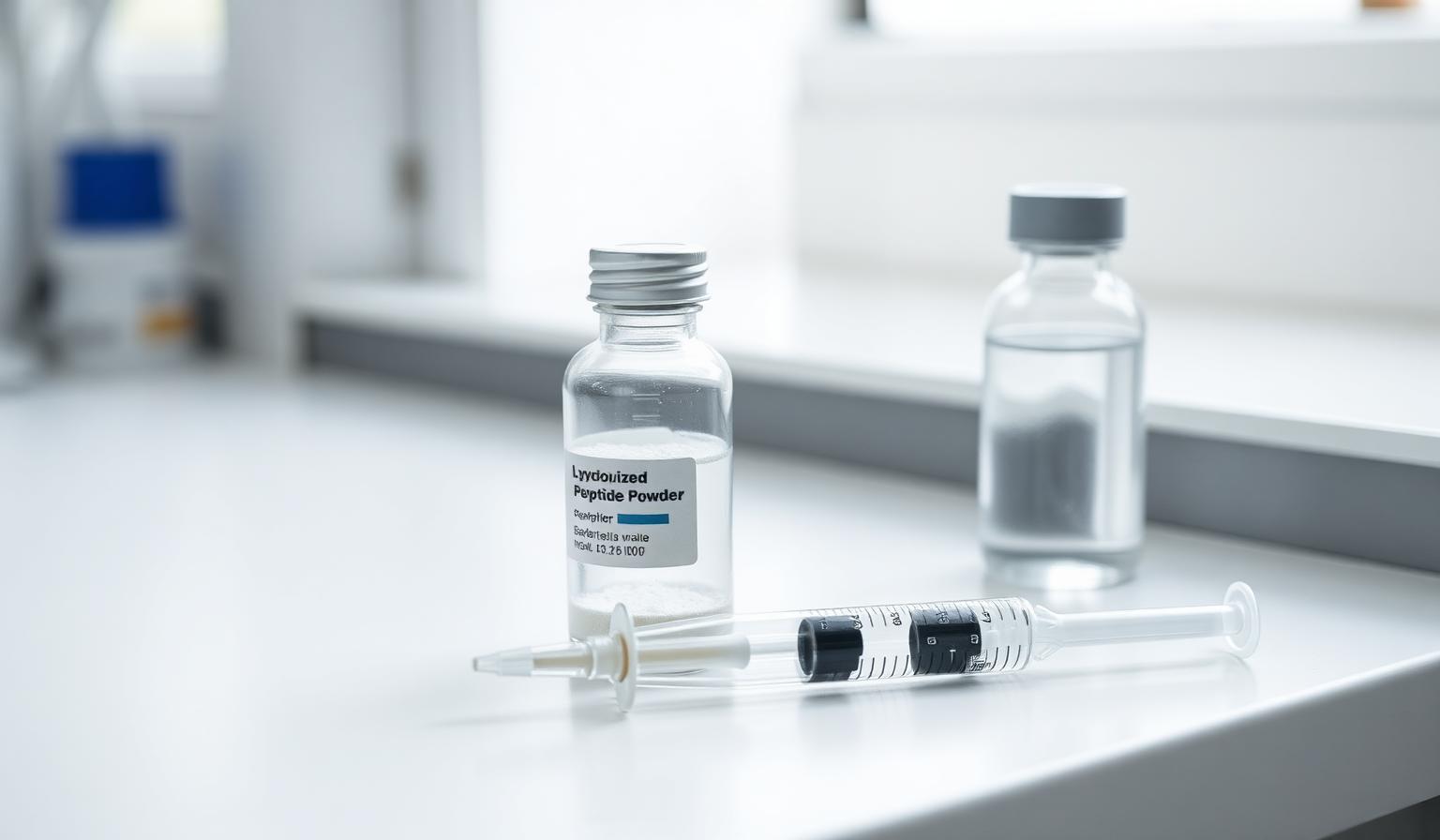
Properly preparing research compounds is a foundational step for generating reproducible and reliable data. For peptides, which are often supplied in a lyophilized or freeze-dried state to ensure maximum stability during transport and storage, this preparation involves reconstitution—the process of dissolving the dry powder into a liquid solution. While seemingly simple, accurate reconstitution requires careful calculation and technique to achieve the desired concentration for investigational use.
Errors in calculating the amount of diluent can lead to solutions that are either too concentrated or too dilute, undermining the precision of an experiment. A methodical approach to reconstitution math ensures that the amount of peptide administered to a cell culture or research model accurately reflects the intended dose. This guide outlines the standard formulas, common tools, and best practices for reconstituting lyophilized peptides for research applications without the headache.
The Core Reconstitution Formula
At the heart of any reconstitution calculation is a simple relationship between mass, volume, and concentration. The goal is to determine the correct volume of diluent that must be added to a known mass of lyophilized peptide to create a solution of a desired concentration.
The primary formula is: Concentration (mg/mL) = Mass of Peptide (mg) / Volume of Diluent (mL)
In a typical lab scenario, the mass of the peptide is a known quantity provided on the vial's label, and the researcher determines the desired final concentration for their experiment. Therefore, the formula is usually rearranged to solve for the volume of diluent to be added: Volume of Diluent (mL) = Mass of Peptide (mg) / Desired Concentration (mg/mL)
Understanding these three variables is key. The mass is the amount of dry peptide powder in the vial. The desired concentration is a strategic choice made by the researcher based on the experimental protocol and the need for dosing accuracy. The volume is the unknown variable that the calculation solves for.
Choosing a Diluent: Bacteriostatic Water
The choice of diluent is critical for peptide stability and sterility, especially if the reconstituted solution will be used multiple times. While sterile water or saline can be used for single-use applications, the standard for multi-use vials is bacteriostatic water. Bacteriostatic water is a sterile solution that contains a preserving agent to inhibit bacterial growth after the vial's septum has been punctured.
A common formulation for bacteriostatic water includes benzyl alcohol as the bacteriostatic preservative. Benzyl alcohol is used in a variety of healthcare applications, including as a preservative in some intravenous medications. Its presence in the diluent helps maintain the sterility of the peptide solution across multiple withdrawals from the same vial, which is essential for preventing contamination in long-term experiments or when sharing a stock solution. For peptides that are sensitive to alcohol, other diluents like sterile water or acetic acid solutions may be required, depending on the peptide's specific chemistry.
Understanding U-100 Syringes
For measuring and administering small liquid volumes, U-100 insulin syringes are a standard tool in many research laboratories. These syringes are calibrated in "units" rather than exclusively in milliliters (mL), which can be a source of confusion. The "U-100" designation refers to a standard concentration of 100 units of activity per milliliter.
This convention simplifies conversions for bench work:
- 100 units = 1 mL
- 10 units = 0.1 mL
- 1 unit = 0.01 mL
Therefore, a 1 mL U-100 syringe will have markings up to 100 units, while a 0.5 mL syringe will have markings up to 50 units. Being able to fluently convert between milliliters and syringe units is essential for accurately adding diluent to a peptide vial and for drawing up precise doses for administration in research models.
Worked Example 1: 5 mg Vial at 5 mg/mL
Let's apply the formula to a common scenario. A researcher has a vial containing 5 mg of a lyophilized peptide and wants to create a stock solution with a concentration of 5 mg/mL.
-
Identify the knowns:
- Mass of Peptide: 5 mg
- Desired Concentration: 5 mg/mL
-
Calculate the required volume of diluent:
- Volume (mL) = Mass (mg) / Concentration (mg/mL)
- Volume (mL) = 5 mg / 5 mg/mL = 1 mL
-
Convert the volume to syringe units:
- Since 1 mL is equal to 100 units on a U-100 syringe, the researcher would draw exactly 1 mL, or 100 units, of bacteriostatic water and add it to the vial.
The result is a stock solution where every 1 mL of liquid contains 5 mg of the peptide.
Worked Example 2: 10 mg Vial at 5 mg/mL
The same principle applies regardless of the vial size. If a researcher has a 10 mg vial of peptide but still desires a 5 mg/mL concentration, the calculation is adjusted accordingly.
-
Identify the knowns:
- Mass of Peptide: 10 mg
- Desired Concentration: 5 mg/mL
-
Calculate the required volume of diluent:
- Volume (mL) = Mass (mg) / Concentration (mg/mL)
- Volume (mL) = 10 mg / 5 mg/mL = 2 mL
-
Measure the diluent:
- The researcher would need to add a total of 2 mL of bacteriostatic water. This can be done by using two full 1 mL U-100 syringes or by using a larger syringe capable of accurately measuring 2 mL.
This creates a 10 mg / 2 mL solution, which simplifies to the target concentration of 5 mg/mL.
Converting From mg to mcg for Dosing
Research protocols often specify doses in micrograms (mcg) rather than milligrams (mg). It is crucial to remember the conversion factor: 1 mg = 1000 mcg. Let's use the stock solution from our first example (5 mg/mL) to calculate the volume needed for a 500 mcg dose.
-
Convert the stock solution concentration to mcg/mL:
- 5 mg/mL * 1000 mcg/mg = 5000 mcg/mL
-
Calculate the volume needed for the desired dose:
- Volume (mL) = Desired Dose (mcg) / Concentration (mcg/mL)
- Volume (mL) = 500 mcg / 5000 mcg/mL = 0.1 mL
-
Convert the volume to syringe units:
- 0.1 mL is equal to 10 units on a U-100 syringe.
The choice of concentration can also impact dosing precision. Administering a small 100 mcg dose from a highly concentrated 5000 mcg/mL solution would require drawing only 0.02 mL (2 units). This tiny volume is difficult to measure accurately and is susceptible to error from bubbles or fluid remaining in the needle hub. By reconstituting at a lower concentration, say 2 mg/mL (2000 mcg/mL), the same 100 mcg dose would require 0.05 mL (5 units)—a larger, more manageable volume that reduces the margin of error.
Correct Reconstitution Technique
Proper handling during reconstitution is just as important as the math. To preserve peptide integrity and maintain sterility, researchers should follow a standard aseptic procedure. After flipping off the plastic cap, the rubber septum of both the peptide vial and the diluent vial should be wiped with an alcohol prep pad.
The diluent should be injected slowly into the peptide vial, aiming the stream against the glass wall rather than directly onto the lyophilized powder. This gentle introduction helps prevent foaming. Once the diluent is added, the solution should be mixed by gently swirling the vial or by inverting it several times. Vigorous shaking is not recommended, as it can introduce shear stress and cause denaturation or aggregation, potentially rendering the peptide inactive. The solution is ready for use once all of the powder has dissolved and the liquid is clear.
Peptide Content vs. Gross Weight
An important consideration for high-precision work is the difference between the gross weight of the lyophilized powder and the net weight of the active peptide. Lyophilization removes water, but the resulting powder is rarely 100% pure peptide. It often includes buffering salts, counterions (like trifluoroacetate from the purification process), and residual moisture.
The total mass listed on the vial may refer to the gross weight. For the most accurate calculations, researchers should refer to the product's Certificate of Analysis (CoA) or technical data sheet. These documents typically specify the peptide purity or net peptide content as a percentage. Using this percentage to adjust the initial mass in the reconstitution formula allows for a more precise final concentration of the active molecule, which is critical for dose-response studies and other quantitative experiments.